
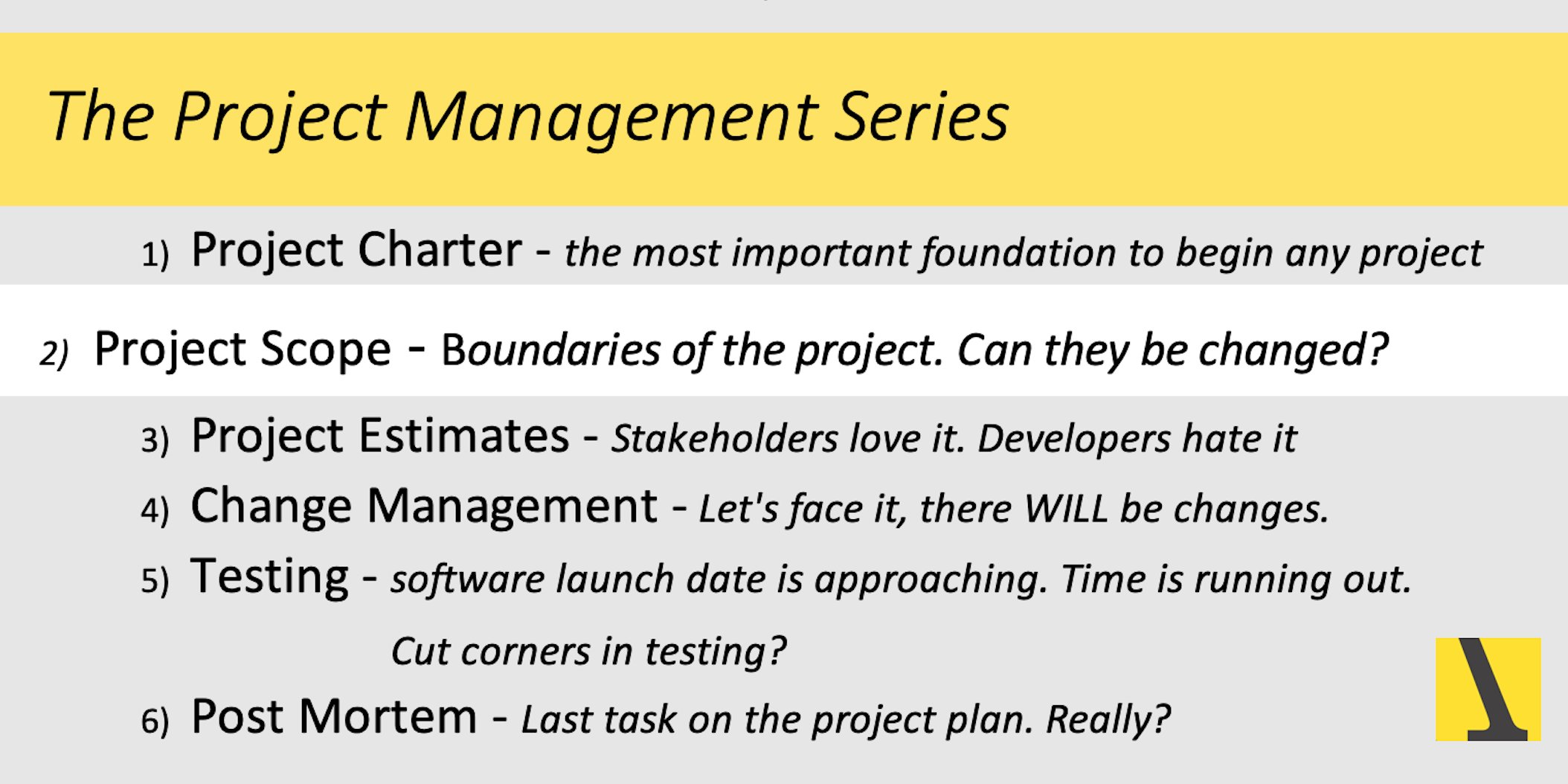
Every project has a scope. Has the scope been well-written? Has everything been accounted for? Once a scope has been set, can it be changed? Traditional project management sees ‘scope’ as the boundaries of the project and labels changes in scope as something negative that would likely delay the schedule and blow the budget. In reality, changes during a project are inevitable, especially for software development.
Let’s take a closer look at how scope should be developed initially and then managed throughout the course of the project, and how to embrace changes.
Why do we need to define a Project Scope?
Don’t get me wrong. When I said a project should embrace changes, I did not mean that it does not require any planning or scope to begin with. And indeed, we do not embrace all changes. We only embrace those that add values to the project or those that can improve the efficiency of the project. How do we decide what changes meet these criteria? That’s where a well thought out Project Scope comes in to play as the baseline.
Let’s go back to the very beginning, or my last blog, Project Charter. To set a scope of a project is to set up a framework to achieve the desired outcome(s). Project sponsors are taking note here, as the desired outcomes are the fundamental justification of the existence of the project. When setting up this framework, or the Scope, one should follow the S.M.A.R.T approach.
Specific – The scope should be as specific as practically possible. The scope is not a project plan. It does not need to include each and every task. But it should capture the specification of the outcome. For example, what features are expected to be included in the software? Prioritize these features into core-must-have features, followed by nice-to-have and even optional features. What platform(s) will this software be run on? What is the expected number of users of this software? And how many are expected to be concurrent users? I have named only a few examples, but you can see already how each of these questions will further shape up the specifics of this project (think: final software feature list, software compatibility matrix and software infrastructure in these examples).

Measurable – If you have specified all the necessary parameters of the project, most if not all of them would become clearly measurable objectives. Following the same examples, the software feature list would be a simple checklist to make sure all features are developed and according to the priority list. The same goes for software compatibility. Your software testing cycle will naturally include all the platforms this software is expected to run on. And system stress testing will reveal if the expected number of users can be supported or even be exceeded.
Achievable – Dream big! Sure, we should all dream big but when it comes to planning and running a project, we need to take the reality into consideration. As we do not have an infinite amount of time and resources, we need to make sure either the goals are achievable within a fixed amount of time and/or budget, or we are certain we could acquire enough resources and have sufficient time to achieve our goals. Otherwise, we would just be setting ourselves up for failure from day one. Also, let’s not forget to include some buffer and contingency planning in the scope to deal with any unexpected situation which, ironically, we are all expecting from past experiences.
Relevant – While changes should not be perceived as something evil by default, we should embrace only those changes that are going to enhance the core values of the project. The Scope lays out the goals of the project and becomes the baseline to evaluate if proposed changes would add value to these goals. At the end of the day, the existence of the project and whether a project is successful is justified by the project sponsors’ satisfaction. So, adopting changes that could add value to the project should be embraced as long as careful cost/benefit analysis has been done and risk level has been re-evaluated in order to help the project sponsors make an informed decision.
Timely – Most if not all projects should have a target completion date, although some might be more time sensitive than others. Project timing is interacting with project specifics, achievability, cost and quality. The timing aspect must be consistent with all these components and spelling out the time constraints upfront could set proper expectation across the board. It also helps with embracing changes. For instance, if a project is time-sensitive, it could still embrace additional features with additional effort as long as some optional features will be dropped to offset the additional time effort.

Once and for all?
I have often seen project plans with ‘Project Scoping’ as an initial task, devoting a considerable amount of time to it. Good effort… but this is not enough. Certainly, the scope should be defined upfront as the baseline of the project blueprint, but it is actually a recurring task that runs throughout the project. Project scope needs to be constantly evaluated to make sure the project stays on track, and it will be used to fine tune the priority of the next few immediate tasks. And as mentioned before, it is being used constantly to justify adopting any positive changes. While the Project Manager is often the assigned owner of the Project Scope, it is imperative for the whole team to develop the scope together and to ensure it is well-received by all stakeholders. The whole-team participation and constant review (or even revision) of the project scope is an important concept of Agile Project Management methodology, which is very popular for software development and will be discussed in later blogs. In summary, don’t fear a change in scope. Establish your project scope well in the beginning, recognise deviation by regular review and analyse its risks and benefits with the S.M.A.R.T approach, and your project will not only stay on track, but develop and grow more attractive to shareholders in the process.
Advivo ICP have recently ‘road-tested’ an exciting Product Launch Evaluation Tool. After answering a series of business questions, it provides you with a snapshot of where to focus your activity within the innovation process to maximise your chances of success. In conjunction with a complimentary 45-minute evaluation session, our team can quickly get you started on the right path to commercialisation.