
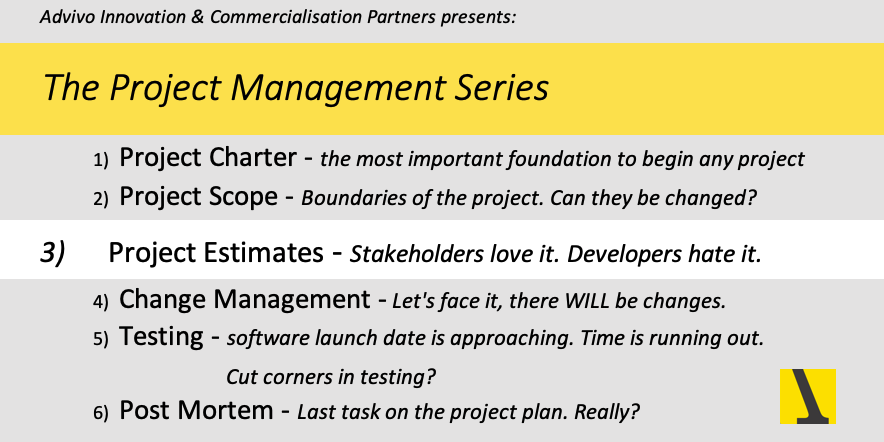
Project Estimates
Stakeholders love them. Developers hate them. Whether they work in your favour or not, it’s only common sense that estimates are vital to all projects.
Project estimates set expectations across the board. They’re the metrics on which major decisions are based. But why is it like pulling teeth out to get estimates from the project team? How can this be turned around? What’s wrong with the estimation process?
Believe it or not, whether you are estimating with simply a pen and a paper, or a sophisticated estimating software, it all boils down to two things – expectation management and trust. Right off the bat, it is common for estimations of fresh projects to be overly optimistic. Why? It is easy to forget this simple rule: Before anyone can sit down to do any kind of estimate, you need to have the project sold to your client first. The sales and marketing team would quote the most optimistic metrics in their sales pitch, claiming that a lot can be accomplished in a very short time and within a very friendly budget. Once it’s turned over to the delivery team, their very first mission then becomes to hold the client’s hands and bring them from the ideal world back to the reality.
The PM’s Responsibility
While the Project Manager is often the person bearing all the good and news in front of the client, he/she is also the individual orchestrating the estimation process. The project manager relies on all team members to contribute their estimates, and then puts them together, makes sure the estimates can be justified and that an appropriate amount of contingency is applied to mitigate risks. Evidently, a good estimate must be a team effort. Asking various team members to come up with an estimate of their own piece of work naturally makes the most sense as they are the experts in their respective areas, and they are the ones actually delivering the work. If they are being asked to estimate something they are very familiar with and/or have done that repeatedly in the past, that usually would be a fairly smooth process. However, if they need to estimate based on a new approach or even a new idea, or there are still quite a few uncertainties, the team could become sceptical to provide any estimate. Experience tells them that if they guess it right, they will be perceived as merely having done their job as expected. If they guess it wrong, they will likely be yelled at. A project team with this mindset would have no incentive to make an effort to come up with any sensible estimate. Rather, they would just rely on their gut feeling and heavily pad the estimate to cover their own bases. Ends up, the estimated effort would be exceeding the client’s expectation by quite a lot, let alone the ideal scenario the sales team was pitching about.
Can Project Estimation be a Win-Win Situation?
There are many estimation techniques out there. Each one has their strengths and weaknesses. Regardless of which technique is adopted, there are a few estimation principles that should be stuck with. As discussed in my earlier blogs, a good Project Charter and a well-defined Project Scope established a good framework for the project. That’s the foundation of having a good project estimate. Once we have those two taken care of, we need to decide if a top-down or bottom-up approach should be adopted. Generally speaking, if there is a hard constraint for the project to be completed by a certain date, the project duration is fixed and a top-down approach is usually more appropriate. This should be clearly communicated to the project team so that everyone is in the same mindset to determine how much time can be afforded for each task. If it becomes apparent that there is not enough time to accomplish all the tasks, a de-scoping discussion is likely required (unless adding costs and resources are viable options). If the quality of the project is the uttermost success criteria of the project, a bottom-up approach usually is more appropriate as it allows the team to estimate sufficient time required to deliver their own piece of work properly.
Enhance Mutual Trust, Improve Estimates
Top-down or bottom up… either approach requires a good justification of the estimate. A defensible estimate is much more convincing and is better received by the audience. This is how the project team can most effectively earn the client’s and the project sponsors’ trust. This would go a long way especially when there are changes down the road eventually requiring some new or re-estimation. Also, the insight of how an estimate was determined makes the thought process as transparent as possible, allowing a better chance to sparkle creative solutions. Once the mutual trust exists, the client’s and the team’s expectations will be much better aligned. Better expectation management will elevate the team’s credibility and enhance the mutual trust, creating a positive snowball effect. To sum it up, an open project atmosphere is vital to encourage candid estimates. As the project team will be (and should be) held accountable for their estimates, they should be treated fairly and respectfully. No estimate will be 100% accurate and that’s why a reasonable amount of contingency is necessary. Only if we can create an atmosphere that the project team wants to estimate, we will have a good and justifiable baseline to begin with, and it will be easier to determine what goes wrong if actual effort takes longer than planned, and come up with a revised and better estimate to move forward. These interactions – which result with better and more respectful relationship between the team and the client – won’t happen overnight. It does take time, discipline and thoughtful practice to make it happen.
Advivo Innovation & Commercialisation Partners has developed a diagnostic tool to assess the commercial viability of new ideas and test assumptions to guide the pathway to market based on factors including those listed above and the knowledge and experience of our commercialisation advisers. The outcomes are used to guide use of data science tools for further market validation and analysis.
If you would like to be a part of our early adopter program and receive a free diagnostic tool consultation, please register below and we will contact you to arrange a 30 min video call to complete the diagnosis and assess your idea’s probability of success.