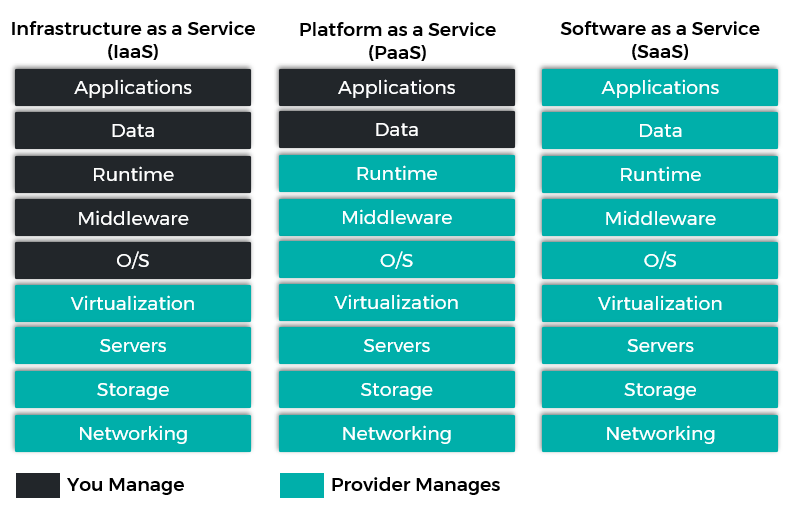
IaaS, PaaS, and SaaS stand for the three main categories of cloud computing. Cloud computing is the practice of using a network of different servers that host, store, manage, and process data online — in “the cloud”.
Let’s go over a quick definition for each of these services.
- IaaS (Infrastructure as a Service): IaaS products allow organizations to manage their business resources — such as their network, servers, and data storage — on the cloud.
- PaaS (Platform as a Service): PaaS products allow businesses and developers to host, build, and deploy consumer-facing apps.
- SaaS (Software as a Service): By far the most common cloud service, SaaS products offer both consumers and businesses cloud-based tools and applications for everyday use.
These software and services can be accessed on any internet browser, or via online apps that can be used on different devices. One key example: the cloud lets your team collaborate on Google Docs instead of forcing you to work on one Microsoft Word document and send it around to each other.
This can be compared with on-premises software, which is installed locally on a server or device at an organization’s physical location.
Software as a service (SaaS)
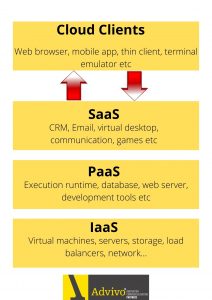
The NIST’s definition of cloud computing defines Software as a Service. The capability provided to the consumer is to use the provider’s applications running on a cloud infrastructure. The applications are accessible from various client devices through either a thin client interface, such as a web browser (e.g., web-based email), or a program interface. The consumer does not manage or control the underlying cloud infrastructure including network, servers, operating systems, storage, or even individual application capabilities, except for limited user-specific application configuration settings.
In the software as a service (SaaS) model, users gain access to application software and databases. Cloud providers manage the infrastructure and platforms that run the applications. SaaS is sometimes referred to as “on-demand software” and is usually priced on a pay-per-use basis or using a subscription fee. In the SaaS model, cloud providers install and operate application software in the cloud and cloud users access the software from cloud clients. Cloud users do not manage the cloud infrastructure and platform where the application runs. This eliminates the need to install and run the application on the cloud user’s own computers, which simplifies maintenance and support. Cloud applications differ from other applications in their scalability—which can be achieved by cloning tasks onto multiple virtual machines at run-time to meet changing work demand. Load balancers distribute the work over the set of virtual machines. This process is transparent to the cloud user, who sees only a single access-point. To accommodate many cloud users, cloud applications can be multitenant, meaning that any machine may serve more than one cloud-user organization.
The pricing model for SaaS applications is typically a monthly or yearly flat fee per user, so prices become scalable and adjustable if users are added or removed at any point. It may also be free.
Proponents claim that SaaS gives a business the potential to reduce IT operational costs by outsourcing hardware and software maintenance and support to the cloud provider. This enables the business to reallocate IT operations costs away from hardware/software spending and from personnel expenses, towards meeting other goals. In addition, with applications hosted centrally, updates can be released without the need for users to install new software. One drawback of SaaS comes with storing the users’ data on the cloud provider’s server. As a result, there could be unauthorized access to the data. Examples of applications offered as SaaS are games and productivity software like Google Docs and Word Online. SaaS applications may be integrated with cloud storage or File hosting services, which is the case with Google Docs being integrated with Google Drive and Word Online being integrated with Onedrive.
Mobile “backend” as a service (MBaaS)
In the mobile “backend” as a service (m) model, also known as backend as a service (BaaS), web app and mobile app developers are provided with a way to link their applications to cloud storage and cloud computing services with application programming interfaces (APIs) exposed to their applications and custom software development kits (SDKs). Services include user management, push notifications, integration with social networking services and more. This is a relatively recent model in cloud computing, with most BaaS start-ups dating from 2011 or later but trends indicate that these services are gaining significant mainstream traction with enterprise consumers.
Serverless computing
Serverless computing is a cloud computing code execution model in which the cloud provider fully manages starting and stopping virtual machines as necessary to serve requests, and requests are billed by an abstract measure of the resources required to satisfy the request, rather than per virtual machine, per hour. Despite the name, it does not actually involve running code without servers. Serverless computing is so named because the business or person that owns the system does not have to purchase, rent or provide servers or virtual machines for the back-end code to run on.
Function as a service (FaaS)
Function as a service (FaaS) is a service-hosted remote procedure call that leverages serverless computing to enable the deployment of individual functions in the cloud that run-in response to events FaaS is included under the broader term serverless computing, but the terms may also be used interchangeably.
Advivo Innovation & Commercialisation Partners use Opportunity Mine™ in our Data Science Tools Suite. Opportunity Mine™ is a methodology that combines human expertise, data science and quantitative research. With this technology, the customer experience – technically known as the ‘basis of competition’ – can be unlocked statistically, to discover transformative opportunities at a fraction of cost and time, with more accuracy.