
Welcome
Trevor Holmes
Managing Director
Our July newsletter is packed with great knowledge articles from our team, covering knowing your market when launching new products, protecting your Intellectual Property by Dr Steve Davis and Marcus van Vugt’s specific look at data science in the health sector.

We are also very proud to be involved with the launch of the “Design the Horizon” Program in conjunction with Future Industries Australia with the first module scheduled for Friday 3rd September. A Taste of Wonderland is designed for those who seek an innovative process to identify opportunities in a world where the strange has become normal and the normal has become strange. In reading Hilary van Welter’s article below, we aim to inspire entrepreneurial thinkers to participate in this extraordinary workshop. Both Linda Ginger and myself participated recently and were amazed at what creative ideas were created in under 2 ½ hours. Certainly, an event that is highly rewarding and very different to what you may have experienced.
If you are considering or in the process of preparing an innovative product or service for launch, do not forget to try our Product Launch Diagnostic Tool. Covering six critical sectors of the commercialisation roadmap, this free diagnostic tool will help you know how well prepared you are to launch.
Enjoy reading and learning in order to gain the knowledge that gives you a higher probability of success and mitigating risk when launching innovative products and services.
If there are specific topics that you as our subscribers would like to know more about, please feel free to reach out with your ideas of topics and our team will be ready to respond in the next issue. You can contact us via our website or follow us on LinkedIn.

We Lack Market Knowledge when Launching New Products
Trevor Holmes
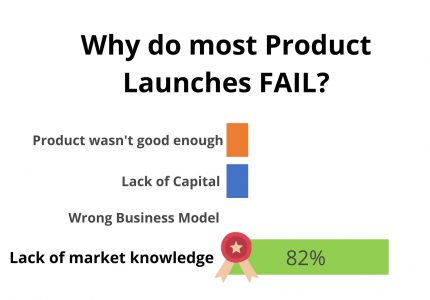
Our recent poll on LinkedIn asked the question, “Why do so many Product Launches fail?” The results showed that an overwhelming 82% of respondents identified a lack of market knowledge as the key cause of new product launch failures. Lack of capital and the product simply not being good enough both returned 9% of the votes, and not one voter blamed the business model as the cause of failure.
From research conducted by our data science partners Attractor Network and Growth Science, we know with a high level of certainty that 77% of the cause of new product failures are exactly that; external factors as opposed to internal factors. i.e. competitors, target market knowledge and business model adoption.
So, what do we read into these results?
We can easily assess that for a poll, most respondents agree that Market Knowledge is a “cause” of successful launches however with new product launch failures in excess of 80%, we do wonder why more companies do not invest in gaining a deeper understandings of their market before investing into innovative ideas?
There are a number of assumptions and observations that can be made about this;
- The innovators do not understand what ‘Job needs to be done’ is
- Lack of capital to invest into “market knowledge”, so they invest mostly into their product (with 4 out of 5 failing anyway)
- Many believe they know the market only to find out that they misread their own beliefs when they eventually launch
- Business model was not trialed and tested in the marketplace
Even mid-tier and larger organisations can and do fail here. They may believe that they already know the market. However, as disruption theory teaches us, a disruptive innovation often means that market entry is going to be directed at the low end or non-consumption market in the early market adoption phase. In other words, this new idea could gain best adoption in different markets to those that a mid-tier or large organisation is used to operating in. Therefore, they do not know the real market as well as they thought.
Today, there are methods of getting to know your market so much more efficiently and cost effectively than in using traditional methods that require a lot of labour resources and can take months to produce. At Advivo ICP and with our data science partners, we are able to utilise cost effective data science tools supported with deep qualitative research techniques that provides you with the market knowledge you need to plot your market entry successfully. Please reach out and submit your enquiry if you would like to know more about knowing your market.
So, you have this great new idea, you’ve bounced it off trusted friends and family who have given you support and encouragement, but if you tell anyone else about it won’t they just steal the idea?
Won’t they steal my idea?
Well, potentially yes, but the more important thing is you need to validate that it is in fact a good idea (that has a market need) before you start investing a lot more time and money into it. Also bear in mind that commercialising an idea requires knowledge of how to go about it and resources, so not everyone is waiting around waiting to pick up and run with an idea like yours, but nevertheless, you do need to be cautious. The best way of ascertaining whether it is good idea is through discussions with potential customers, so what is the best way to go about that with minimal risk of losing your Intellectual Property (IP)?
Is there a market need?
Before discussing your idea too widely you need to do some background homework and really analyse what problem you are trying to solve with your idea. What is the actual job to be done which your idea is making it possible to do, or making it much easier and more efficient to do? Once you know the answer to that, you need to research how that job is currently being done and what other solutions you are going to be competing with. You need to know what your advantages are over other ways that job is being done now to be able to have a meaningful discussion with potential users of your idea. You need to be well across the current state of the market around your idea in order to be able to clearly articulate your value proposition.
Barriers to Entry
The degree of risk in others being able to copy your IP is dependent on the strength of the barriers to entry associated with your idea. The strongest barrier to entry to competitors utilising your idea is patent protection, but in many cases formal patent protection may not be an option, particularly for software ideas. Patents are also expensive, and the expense is not warranted unless the patent is strong and enforceable (a subject which will be explained in a future article). There are however other forms of barrier to entry, for example complexity of design. If the design required to implement the idea is complex it will be difficult for others to reverse engineer. This applies to software as well as hardware, which may have complex structure and functionality, or it may contain smarts within the code which are based on proprietary algorithms or method combinations. A unique data set not readily available to others used to train machine learning to implement the idea would also be another example of a barrier to entry.
Talk to your potential customers
In any case regardless of the strength of barriers to entry to competitors, you need to talk to potential customers to validate they would consider buying your idea for the job to be done. These conversations will be invaluable in refining your idea and being able to define a minimum viable product with which to enter the market. It is also important to make sure to canvas a wide cross section of opinions to make sure you are getting statistically meaningful results, there will always be differing opinions, but you are looking for a general consensus which supports potential adoption of your idea.
Sign a Non-disclosure Agreement (NDA)
It is good practice to have parties you are disclosing the idea to sign a non-disclosure agreement (NDA). An NDA is not a guarantee of confidentiality, but it does provide some degree of protection. If they do not want to sign an NDA, you need to think carefully about the value in proceeding with the discussion. If there are strong barriers to entry it is less of an issue, but if not then the risks are obviously much higher. An option in that case could be to discuss how they are currently carrying out the identified job to be done, what the pain points and/or potential gains are, and how important it would be to them to have a better solution. This can all be done without necessarily revealing full details of the idea you have for the solution, and whilst not providing feedback directly about your idea it is providing feedback as to whether there is a market need which the idea addresses.
So, the answer is talk to potential customers about your idea to make sure you are on the right track, however, be cautious in how you go about it to protect your IP. Be cognisant of the barriers to entry for competitors and adjust your approach accordingly.
If you have an innovative concept and are unsure of the next steps, please contact our office.
Happy New (Financial) Year!
The Biggest Technology & Business Trends of 2021
Jasmine Hodson
Innovation & Commercialisation Analyst

In our most recent poll, we asked you to rank some of business and technology’s biggest trends of this past financial year. Online education and remote work technologies ranked highest to you, although you also acknowledged the success of telehealth service and online shopping trends.
The Covid-19 pandemic forced the hand of many industries to innovate or fall. Spectacular pivots and innovations built some of the most impressive trends of the year. Remote work, as one example, led to an increase in productivity in some companies, and many businesses are now considering making the permanent switch to virtual offices, with innovative new tools providing cutting edge online solutions for communication and collaboration.
Aside from those voted for in the poll, here are some of this past financial year’s biggest business trends.
Business Model Innovation
The tests of adaptability of businesses through the pandemic have prompted the necessary trend of business model innovation. Every business leader has had to reflect on their product or service offering, whether it holds value for customers, and how they are operating as a business. The businesses that are thriving in 2021 are those whose leaders were able to react most efficiently to change. High-end restaurants pivoted to offer takeaway, car companies produced ventilators, to ensure survival and even boost their corporate social responsibility standing.

Automation
Automation tools are soaring as well as remote work offerings, with many businesses needing to find ways to cut down on unproductive hours spent on data entry and double handling. Automating more business processes has the duel reward of saving money and time, while also keeping more work online and taking away unnecessary back-and-forth communication.
Decentralised Finance
With the economic turbulence and traditional funding methods looking somewhat uncertain to small businesses, solutions for capital-raising have been found in decentralised finance options such as blockchain technology and crowdfunding.

Global to Local
An exciting area where we are still waiting to see the magnitude of the pandemic’s impact is the rise of local production. Local business, local manufacturing, is being invested in an Aussie manufacturers are seeing opportunities that had only a few years ago been taken away by globalisation. With impacts that reach as far as environmental sustainability improvements, increase in local manufacturing will have some interesting outcomes. Australia’s GDP was made up almost 30% by the manufacturing industry in the 60s, but by 2020 it had fallen to just 6%. The exact impact of this slow-burn movement is yet unknown, but we are certainly paying attention.
Does your company need to consider innovation in its business model? Are you wondering if the time has come to pivot your strategy?
Our team of Innovation and Commercialisation experts are well-versed in disruptive techniques that could benefit your business. Reach out to us today.
Design The Horizon
How to discover a wonderland of opportunities in chaos and uncertainty
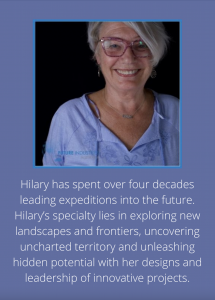
Hilary van Welter
When I look around at what is happening in myself, my family, my clients, my community, my country and in the world, I see us in this massive ‘Hallway of the In-between’. We have left one world and are in transition to another one, catapulted in many ways by the pandemic and the ongoing aftershocks of how this virus has impacted all our systems, communities and marketplaces. What we do in this ‘hallway’, amidst the breakdowns, anxiety, fear and unknowns that surround us will shape the new emerging horizon – no matter what country we are in.
Yet, the human spirit is rising, and a radical reimagining of business is becoming a powerful vehicle for the shaping of a new horizon of a future that some are calling a regenaissance (Regeneration + Renaissance).
Having been on the front lines of disruption and innovation for over four decades developing strategic change initiatives, I have learned that sometimes the simplest of tools are best for cutting through the noise and the disturbance of the old to explore where the opportunities lie.
I have also realized that times of great change begin with a personal reflection, an opportunity to check out what has been happening in our inner world as well as well as tapping into the exciting changes that are arising.
A holistic experience is being called for, so we don’t just upgrade our current reality, but take a once in a lifetime opportunity to be part of a global transformation.
And so I, along with wonderful Australian, Alex Pantea, whom I met in a Zoom chat at a Crowd Sourcing conference in September of last year, codesigned A Taste of Wonderland (TM). It all began with a comment about how it felt we had ‘fallen down the rabbit hole’ in the Alice in Wonderland story in which the strange became normal and the normal strange. This story became the framework that inspires the imagination and curiosity – vital tools for shaping a ‘new world’. And this framework became the launchpad for the new collaborative initiative ‘Design the Horizon’.
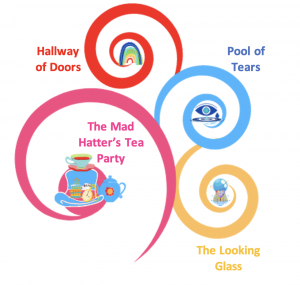
This process of reimagining business begins with the Hallway of Doors, where Alice struggled to get through the doors. Our Doors help to identify the struggles in the form of cracks and breakdowns that are currently happening. These can range from the fears and doubts about our ability to cope and the impact this is having on our families; to the people, businesses and systems that have been devasted at no fault of their own. There are cycles that are ending, along with something new that is waiting to be born. These are the cracks and breakdowns that open up the breakthroughs and possibilities for the new.
The next step in the process surfaced out of Alice’s incessant crying at not being able to get through the doors which ended up causing the Pool of Tears. It is here that we explore what we are grieving and need to let go of. The grieving process is not often part of uncovering business opportunities, and yet is a critical experience of identifying what we must set free, in order to welcome the new. We have all been grieving the loss of liberties, face to face contact, and ways of life and things we felt entitled to. We have lost certainty and there are situations that are making us angry like the hypocrisy we see around us. At the same time there are circumstances that make us feel powerless. Now is the time to declare these pain points as they are vital players in the human process of business transformation.
Once we have identified the indicators of change in the cracks and our pain points, we are ready to explore ‘what’s new’ by tapping into exciting new trends that have emerged over the past year. This is our Looking Glass, which as in Alice in Wonderland, is an alternative reality. These aren’t conceptual ideas; they are living innovations that provide a much needed ray of hope for the journey ahead.
What makes the Taste of Wonderland (TM) truly unique is the next step: The Mad Hatter’s Tea Party. Here is where the ‘magic’ happens through the blending of ingredients from the Hall of Doors (cracks and breakdowns) The Pool of Tears (Pain points); and the Looking Glass (WOW ideas) into new concepts and opportunities. We have seen new product ideas, new business ideas, along with innovative financing, resourcing and funding models. New forms of business and services have emerged that are truly rising to the challenges we face. These opportunities are grounded in the changes we want to bring yet inspired by imagination. Underlying these new concepts is a new paradigm of business that is emerging.

Past participants have told us how much they enjoyed the time out to get in touch with their conscious / unconscious thoughts in unconventional ways, along with the connectivity with others’ experiences of this disruptive time and knowing they’re not alone.
The sense of endless possibilities was also a welcomed realization at a time when we often feel powerless and constrained by limitations. Participants have left the process reinvigorated along with approaches that can be implemented immediately as well as seeds of new ideas to be cultivated and grown.
It has been surprising how a well-loved theme of Alice in Wonderland is relevant to business transformation. And yet as the Queen says to Alice ‘Why, sometimes I’ve believed as many as six impossible things before breakfast.”
We would love for you to join us on this new adventure to Design the Horizon, to discover a wonderland of opportunities in chaos and uncertainty.

So you want to launch a product into the Health Sector?
Marcus van Vugt
Innovation & Commercialisation Specialist
At Advivo Innovation & Commercialisation Partners, we are using leading edge data science tools in conjunction with our disruption processes to provide clients a new depth of understanding on the market for their new idea.
To steal Douglas Adams’ words, ‘Health care is big. You just won’t believe how vastly, hugely, mind-bogglingly big it is’. The global health industry has an annual spend of over $6 Trillion, half of that spent in the US, the other half spent across the rest of the world. In terms of new activity in the sector via VC and PE deals, the first quarter of 2021 saw an additional $31.6Billion globally in equity funding with global digital health equity funding jumping by 9% QoQ. Activity grew significantly across the use of Artificial Intelligence, Telehealth, Medical devices, Mental Health, Women’s Health, Omics (range of Biology related disciplines such as genomics) and general Health IT.
The global health industry has an annual spend of over $6 Trillion.
What is interesting is that the increasing cost structure of health care has a negative labour productivity. Innovation is therefore key to driving better patient outcomes as well as managing the cost structures across all areas of primary, secondary, allied health and government. Outside the core health services we are seeing a lot of innovation across the ‘Health and Wellness’ and preventative space, not only by the large players (with corresponding large innovation budgets) but also through individuals who have identified a better way of doing things.
I recently attended, remotely of course, a US symposium where a number of innovations were presented and judged. Happy to say that one of the winners was a gentleman who has spent the last few years rebuilding and testing prosthetics for his own hand and is now seeking to make the technology available to other medical devices companies. Not sure I’m up for 3D printing my own body parts as yet, but a market exists.
A quick search of the web will give you details of how the Health sector is segmented into at least 80 distinct areas of service and product delivery. To bring your idea to life, you are going to need to know the market you are entering. Generic data research organisations can provide a high-level overview of the size of a market, general trends and details on the leading companies in those markets. The challenge with innovation, and to improve your probability of success, is that you really need to know all of the companies playing in your space as well as understanding which specific segments you should compete in.

A Global Perspective
Often, we deal with clients who are convinced that no-one is playing in the market that they believe suits their idea. The challenge with Health is that it is global and therefore you need to understand the market at a global level. We are working with a range of tools that take a Global, Big Data perspective so that we can determine, on a global basis, which organisations play across the market.
This approach goes well beyond the traditional desktop market research tools and is able to map markets by identifying all the companies involved and across each of the segments within that particular market. The power this gives us is clear: a complete landscape of the market you’re looking to enter. We are able to identify how crowded a market is and who the actual players are in that market. We spot the ‘crowds’, and then suggest a targeted entry approach by identifying any white space opportunities in the market or alternatively any adjacent market opportunities. Understanding who is competing in your potential market drives better and more relevant competitor analysis and serves to identify potential collaboration or licensing targets.
The market mapping assessment provides a very good overview of the competitive landscape but can also be used to map the landscape of the potential consumer market or to identify options in monetising your idea to existing players.
Professional Advice
There is a considerable amount of strategy and validation work needed to determine what tools and searches will derive real value in determining the commercial viability of an idea. The quality of the data is heavily dependent on the structure of the search terms used in Big Data analytics. To support any research findings and to gain a higher probability of commercial success, how will you proceed? The questions we begin with as commercialisation experts include:
- Who the ultimate consumer is and what market segments they occupy?;
- What is the job to be done and what is the value proposition delivered through the proposed solution?;
- Who is the competition?;
- What is the Minimum Viable Product (MVP) and Minimum Viable Audience (MVA) required to enter and further test the market? [This is particularly relevant in various Health sectors given the regulatory framework that needs to be addressed across different jurisdictions];
- How will we test the market to determine the the value of the idea including any functional and commercial aspects;
- How do we determine the requirements and ability to scale?;
- What is the financial plan required for product development and go to market?;
- How will you protect the IP in your idea with a view to setting barriers to entry into the market?;
- What will your team look like, what skills and resources are needed?;
- The team required – skills and resources
Advivo Innovation & Commercialisation Partners have a diagnostic tool to help you assess the commercial viability of any new idea and test assumptions to guide the pathway to market and how you can leverage the knowledge and experience of our innovation and commercialisation advisors. The outcomes are used to guide use of data science tools for further market validation and analysis.
Please register below and we will contact you to arrange a 30 min complimentary video session to complete the diagnosis and provide thoughts around your idea’s probability of success.